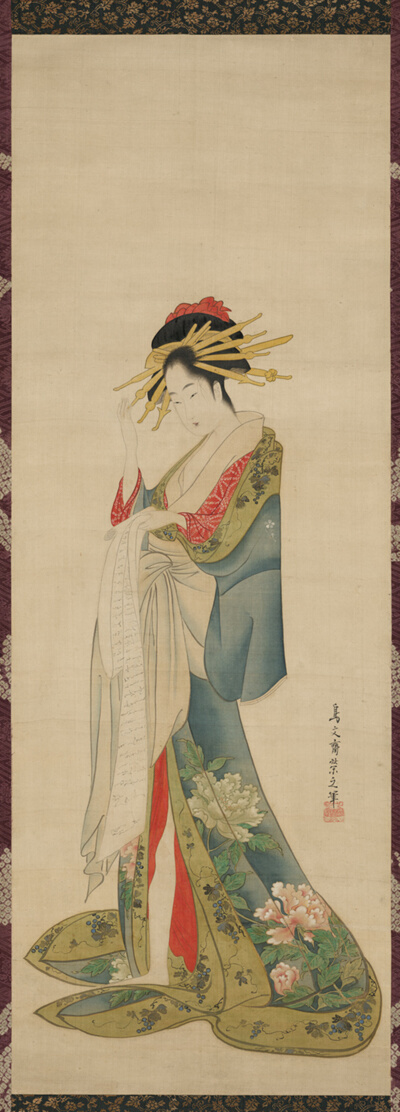
An Artifact of Discretion: Interrogating the Material Syntax of a Courtesan's Correspondence
To the connoisseur of material heritage, the artifact presents itself not merely as an image, but as a statement of intent. The piece in question—a hanging scroll depicting a courtesan in the act of reading a letter—demands an appraisal that transcends the pictorial. Its substance is its argument: silk. This is not a support chosen for mere convention, but a deliberate, calculated selection that informs every aspect of the work’s ontology. The silk ground, with its characteristically fine, luminous tooth, accepts the mineral pigments and ink not as a passive recipient, but as an active collaborator. The resulting application is one of profound depth and softness, a visual tonality impossible to achieve on the more absorptive, rustic surface of paper. The colour, particularly in the subtle gradations of her robes—perhaps a dawn-pink or a muted lavender—retains a suspended, atmospheric quality, as if the very hues are held in a state of elegant tension upon the warp and weft. This material choice immediately elevates the subject from the ephemeral to the enduring, framing a moment of private intimacy within the most permanent and luxurious of mediums.
The Grammar of Elegance: Silhouette, Drapery, and the Unspoken Protocol
The figure’s elegance is not a matter of ornament, but of line and drapery, cut from the same philosophical cloth as a bespoke garment from Savile Row. Here, the cut is defined by the brush. The flow of her robes is rendered with a calligraphic assurance that implies an intimate understanding of form beneath fabric. Each line describing a fold or fall is precise, purposeful, communicating the weight, texture, and movement of the silk she wears. This is a tailored elegance, where the empty space—the negative shape—is as critically considered as the positive. Her posture, likely a graceful contrapposto, speaks of a cultivated bodily intelligence, a performance of refinement that is both instinctual and studied. The setting, spare and suggestive, follows a similar protocol. A single piece of scholar’s furniture, a glimpse of a garden rock or a slender branch—these are not mere background details but essential accessories, the equivalent of a perfectly chosen pocket square or a discreetly excellent pair of cufflinks. They establish a context of cultivated taste, positioning her within a world of aesthetic and intellectual currency, rather than overt sensuality.
The Central Act: Correspondence as a Transaction of the Highest Order
The narrative pivot, the letter itself, must be understood as the focal point of a complex transaction. This is no trivial note. In the context of the elite courtesan, correspondence was a medium of negotiation, poetry, patronage, and politics—a vital tool in the management of reputation and relationship. The act of reading, therefore, is one of intense concentration and strategic interpretation. Her expression, masterfully rendered through minimal strokes, would convey a universe of meaning: contemplative absorption, perhaps a flicker of analytical assessment, or the faintest softening indicative of personal affect. The scroll she holds is a tangible token of a connection, its contents holding the potential to alter her social and financial calculus. The artist’s skill lies in freezing this moment of receipt and processing, allowing the viewer to apprehend the significance, but never the secret. It is a study in controlled disclosure, mirroring the very essence of the courtesan’s profession.
Patina & Provenance: The Accumulation of Authority
The value of such an artifact, like a heritage-listed tailoring house, is compounded by its journey through time. The silk, though inherently robust, may show a dignified patina—soft, subtle craquelure in the pigment, a gentle darkening of the ground that serves not as a flaw, but as a testament to its endurance. Each mounting, each careful preservation, adds a chapter to its biography. The colophons and seals of collectors appended to the scroll are not mere marks of ownership; they are a chain of custody, a provenance that burnishes its significance. These annotations are the equivalent of a garment’s label bearing the signatures of master cutters across generations. They authenticate, they elevate, and they embed the work within a continuous narrative of scholarly and aristocratic appreciation, separating it decisively from the realm of decorative art and positioning it firmly within the canon of cultural patrimony.
In final analysis, this hanging scroll is a masterclass in the communication of status through understatement. Every element—from the foundational luxury of the silk, to the tailored elegance of the drapery, the profound significance of the narrated act, and the accrued authority of its age—conspires to articulate a singular thesis. It presents the courtesan not as a mere object of desire, but as a formidable actor in a sophisticated social theatre. She is a curator of taste, a strategist of emotion, and a connoisseur of the finer points of human exchange. The artifact, in its material grandeur and narrative subtlety, does not simply depict this reality; it embodies it. It stands as a peer to the most revered examples of material culture, where substance and story are inseparably fused, commanding respect through a quiet, impeccable, and utterly persuasive authority.