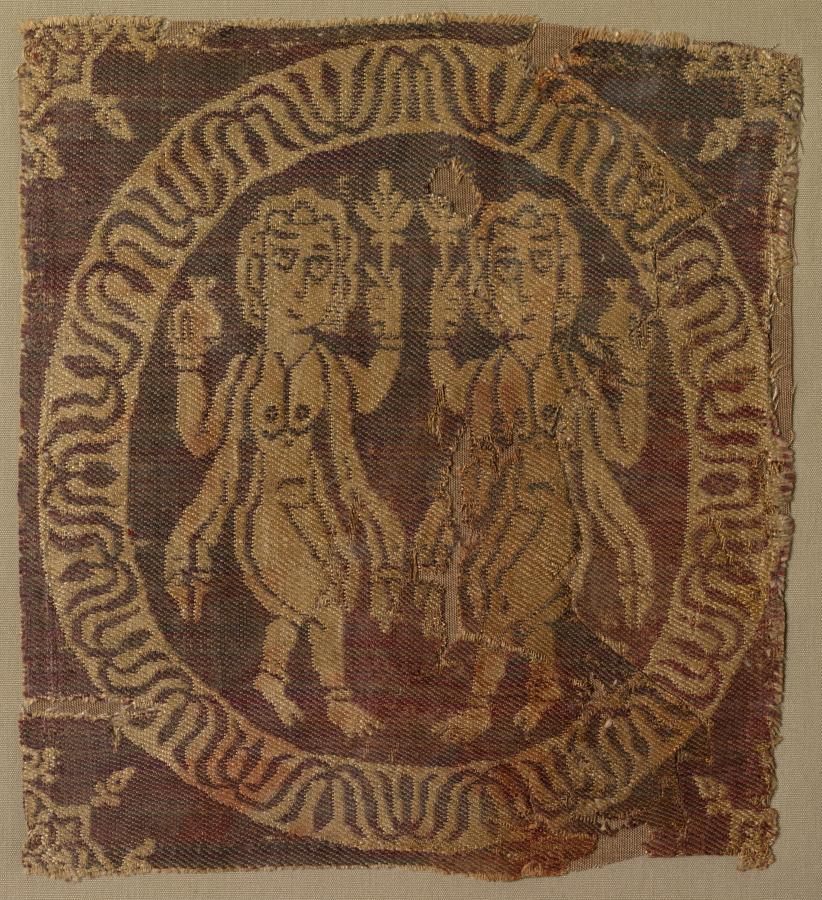
An Exegesis of Emergence: The Nude Female Dancer from a Tunic
To consider the artifact—a figurative panel depicting nude female dancers, liberated from its original context as a segment of a tunic—is to engage in a profound dialogue with the very essence of imperial ambition and its material manifestation. We are not merely examining a textile fragment; we are conducting a forensic audit of power, aesthetics, and sublime technical arrogance, rendered in the most demanding of mediums: silk. The subject matter, ostensibly one of bacchic revelry or celestial homage, is, in fact, a deliberate and sophisticated proclamation. It speaks not of the body unadorned, but of the body reimagined through the loom, a testament to an empire’s capacity to command nature’s most elusive filament and transform it into a vehicle for enduring ideology.
The Foundation: Silk as Imperial Prerogative
One must first apprehend the foundational truth of the material. Silk was never merely a fabric in the imperial context; it was a geopolitical instrument, a economic cipher, and a rigidly enforced symbol of status. The very possession of sericulture, smuggled though its secrets may have been, constituted a state monopoly of the highest order. The cultivation of the mulberry, the rearing of the Bombyx mori, the laborious unreeling of the cocoon—this was an agricultural and logistical ballet as carefully choreographed as the dancers depicted upon its surface. The resulting filament, a continuous protein strand of breathtaking strength and luminosity, was the physical substrate of power. To drape oneself in figured silk was to cloak oneself in the authority of the state itself. Thus, the tunic from which our dancer fragment derives was, in its original totality, not an article of clothing but a uniform of privilege, a mobile assertion of one’s place within the celestial-ordained hierarchy.
The Artifact: A Study in Contrapuntal Tension
Herein lies the exquisite tension of the artifact. The subject—the nude female form in motion—represents the apogee of natural, unconstrained freedom. Yet its execution is the product of the most constrained, technically obsessive process known to the pre-modern world: compound silk weaving, likely on a draw-loom. Each curve of a hip, each suggested torsion of the torso, is not painted or embroidered, but architected in warps and wefts. The flesh is not flesh, but an intricate tapestry of complementary hues, its volume suggested by the subtle modulation of shade created by multiple sets of binding warps. The dancer’s movement is frozen, yet the very sheen of the silk ensures this stillness is illusory; with every shift in the observer’s position, the figure seems to shimmer, to breathe, to recommence her dance. This is the imperial paradox made material: the celebration of pagan joie de vivre through a medium that demanded militaristic discipline and inexhaustible resource. The weaver, an anonymous master, has achieved the ultimate sartorial sleight of hand: presenting effortless grace through a medium of excruciating effort.
Legacy and Lineage: The Weave of Continuity
The legacy of this imperial silk weaving is not one of mere historical curiosity; it is a direct and traceable lineage to the canons of luxury that define the highest echelons of bespoke creation today. Consider the Savile Row ethos: the transformation of the finest raw materials—a bale of Super 180s wool from a specific flock, for instance—into a garment that appears effortless, where structure is concealed beneath drape, and where every seam serves an aesthetic as well as a functional purpose. The imperial silk weavers were the original bespoke artisans. The tunic was a commission, its iconography personally and politically significant. The precision required to align the figurative panels symmetrically across the garment’s seams speaks of a patron’s measurement and a narrative intent, no less than the fitting of a coat’s shoulder line or the sweep of its skirt. The fluency with which these classical motifs were translated into thread established a visual vocabulary of luxury that echoed through Byzantine opus anglicanum, Renaissance velvets, and ultimately into the very understanding of figured cloth as a canvas for personal and dynastic statement.
Furthermore, the fragment’s survival—its liberation from the utilitarian fate of the worn tunic—parallels the modern preservation and study of heritage tailoring patterns and craft techniques. It is a distillation of principle. We study not the entire garment, but the essential motif, the proof of concept. It tells us that the ambition was not simply to clothe, but to awe. The nude dancer, in her silk prison, is both captive and conqueror. She is captive to the rigid geometry of the loom’s grid, yet she conquers that very grid by introducing the fluidity of life. This is the perpetual pursuit of the luxury artisan: to impose human genius upon resistant material, to make the difficult appear innate, and to ensure that the final form transcends its constituent parts.
Conclusion: The Unbroken Thread
In final analysis, this heritage research artifact—this nude female dancer from a tunic—stands as a silent yet eloquent witness to a system where aesthetics were inseparable from authority. The silk is its sinew, the weave its bone structure, the iconography its soul. It reminds the contemporary curator of heritage that true luxury is never superficial; it is archaeological. It is built in layers: of technical mastery over a coveted material, of symbolic narrative woven into the very fibre of the object, and of an audacious desire to render the ephemeral—a dance, a moment of revelry, a breath—into an artifact of permanent cultural weight. The imperial loom may lie silent, but the language it spoke, of ambition rendered tangible through sublime materiality, continues to be the only language worth speaking in the rarefied ateliers of the world. The thread, dear reader, remains unbroken.