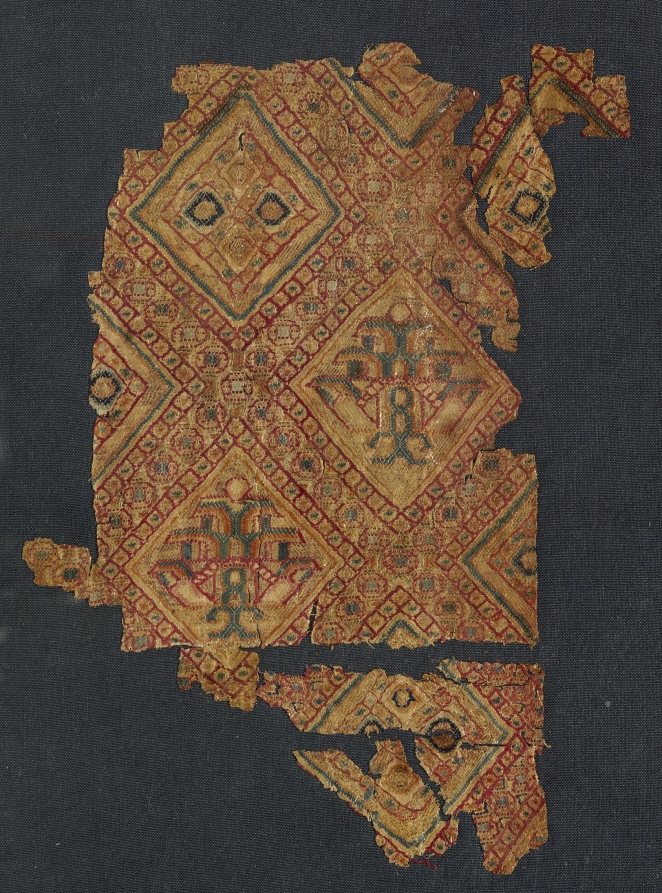
The Fragment as a Testament: Deciphering the Legacy of Imperial Silk Weaving
In the hushed ateliers of London’s Savile Row, where the weight of a cloth is measured not merely in ounces but in centuries of provenance, the fragment with jewel-like silk stands as a singular artifact. It is not a garment, nor a remnant of a completed whole, but a deliberate, preserved sliver of a much grander narrative. This piece, a microcosm of the imperial silk weaving tradition, speaks to a lineage of craftsmanship that defined not only the opulence of courts but the very standards of textile excellence. To the discerning eye, this is not a fragment of decay; it is a fragment of a lost language, a codex of silk, dye, and loom that demands rigorous scholarly attention.
Materiality: The Silk as a Primary Source
The materiality of this fragment is its first and most commanding testimony. The silk itself, a filament of unparalleled fineness, is the product of Bombyx mori cultivation, a process perfected over millennia in the imperial sericulture of China. The thread count, the twist, the lustre—each element is a fingerprint of a specific workshop, likely one operating under the direct patronage of the Ming or Qing dynasties. The term “jewel-like” is not a poetic flourish but a technical description. The silk’s surface, when examined under a loupe, reveals a weft-faced compound weave, where the supplementary wefts are of such tight, even tension that the ground weave is entirely obscured. This creates a fabric that behaves like a gemstone: it reflects light in a prismatic, almost liquid manner, shifting from deep sapphire to emerald and topaz as the angle changes. This is not a dye; it is a structural illusion. The dyes themselves, likely derived from indigo for the blues and madder or cochineal for the reds, are fixed with alum mordants, a technique that ensured the colours would not fade even after centuries of storage in the dry, dark conditions of a palace treasury. The fragment’s edges, cleanly cut rather than torn, suggest it was a sample—a specimen—perhaps used by a master weaver to demonstrate a new pattern to the Imperial Household Department. It is a piece of evidence, not a piece of waste.
Context: The Imperial Silk Weaving Legacy
To understand this fragment, one must first understand the ecosystem that produced it. Imperial silk weaving was not a cottage industry; it was a state-sponsored, highly regulated monopoly. The Jiangnan region, particularly the cities of Suzhou, Hangzhou, and Nanjing, housed the Imperial Silk Workshops, where thousands of artisans worked under the watch of eunuch supervisors. The looms used were the drawlooms, complex machines requiring two operators: a weaver and a drawboy who pulled the pattern harnesses. The fragment’s pattern—a repeating motif of clouds and dragons or possibly lotus scrolls—would have been designed by a court painter, then translated into a pattern draft on paper, a document as valuable as the silk itself. The production of a single bolt of imperial silk could take months, and the cost was astronomical. This fragment, therefore, is not merely a textile; it is a product of a sophisticated bureaucratic and artistic apparatus that controlled the very definition of luxury.
The legacy of this system is profound. The techniques perfected in these workshops—the k’o-ssu (cut silk tapestry) and the satin weave—became the benchmark for global textile production. When the Silk Road brought these fabrics to the courts of Europe, they were immediately coveted. The fragment’s jewel-like quality is a direct ancestor of the brocades and damasks that would later be woven in Lyon and Spitalfields. The Savile Row tailor, in his use of a silk lining for a bespoke suit, is unknowingly inheriting a tradition of precision and material reverence that began in these imperial workshops. The fragment is a missing link, a physical connection between the opulent robes of a Chinese emperor and the understated elegance of a London-cut dinner jacket.
Preservation and Interpretation: The Artifact’s Current Life
Today, this fragment is a conservation challenge and a research opportunity. It is likely stored in a pH-neutral, acid-free box, wrapped in unbleached muslin, and kept in a climate-controlled environment at 18°C and 50% relative humidity. The silk is fragile; the jewel-like sheen is a result of the fibres’ smooth, unscaled surface, which is also its weakness. Light damage, even from low-level UV, can cause the dyes to shift and the fibres to become brittle. The fragment’s provenance—its journey from the imperial workshop to a private collection, perhaps via the Opium Wars or the Boxer Rebellion—is a story of loss and acquisition that must be handled with ethical sensitivity. It is not merely a beautiful object; it is a piece of cultural heritage that was often looted. The scholar’s task is to interpret the fragment’s technical brilliance while acknowledging the colonial context of its dispersal.
In conclusion, this fragment with jewel-like silk is a masterclass in material culture. It teaches us that silk is not a static material but a dynamic record of human ingenuity, imperial ambition, and global exchange. For the Savile Row practitioner, it is a reminder that true luxury is not about excess but about the relentless pursuit of perfection in every thread. The fragment is small, but its legacy is vast. It is a jewel, yes, but one that holds within it the entire history of a craft that shaped the world’s understanding of elegance.