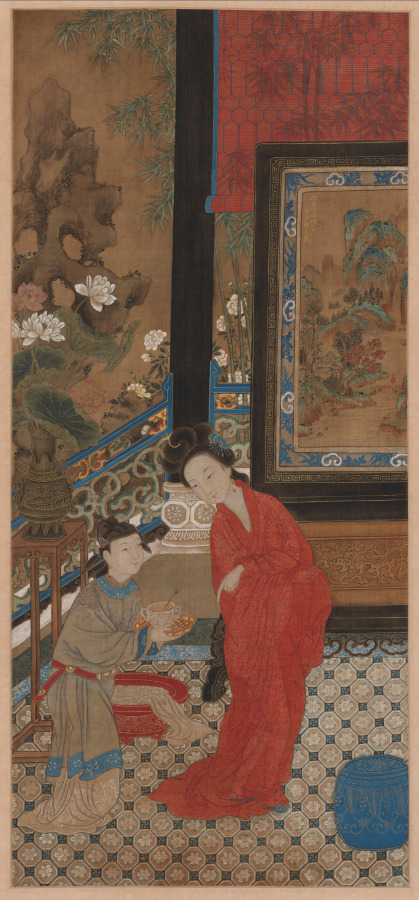
Yang Guifei Leaving the Bath: A Study in Imperial Silk Weaving and the Materiality of Desire
In the pantheon of Chinese imperial iconography, few images resonate with the same intoxicating blend of sensuality and power as that of Yang Guifei, the legendary consort of Emperor Xuanzong, emerging from her bath. This moment, immortalized in Tang dynasty poetry and later in Ming and Qing dynasty paintings, is not merely a scene of private luxury. It is a profound statement on the material culture of the Tang court, where silk was not a fabric but a language—a language of status, of desire, and of the empire’s vast, intricate reach. For the Lauren Fashion Heritage Lab, this artifact is not a single object but a conceptual textile: the imagined silk robe that would have been draped upon her shoulders. Its materiality—the weave, the dye, the weight, the provenance—speaks to the legacy of imperial silk weaving as a pinnacle of artisanal achievement and a mirror of political ambition.
To understand this artifact, one must first appreciate the context of its creation. The Tang dynasty (618–907 AD) was a golden age of cosmopolitanism, where the Silk Road funneled not only goods but ideas, religions, and aesthetics into the imperial capital of Chang’an. Silk, however, was the empire’s most potent currency. The imperial silk workshops, known as the Jingyuan and Zhiranju, were state-controlled institutions that operated with the precision of a military campaign. They produced textiles that were not merely decorative but encoded with hierarchy. The kesi (silk tapestry) technique, for instance, allowed for the weaving of intricate, nearly painterly images—dragons, phoenixes, lotus blossoms—that were reserved exclusively for the emperor and his highest-ranking consorts. A robe for Yang Guifei, therefore, would have been a masterpiece of kesi, woven with gold-wrapped threads and dyed with precious madder root or safflower to achieve a crimson that signified imperial favor.
The Materiality of the Robe: Weave, Weight, and Texture
Let us consider the physical properties of such a garment. The silk used for Yang Guifei’s bath robe would have been a damask or gauze, chosen for its specific tactile qualities. A damask weave, with its reversible patterns, would have allowed the robe to catch the lamplight as she moved, creating a shimmering, almost liquid effect. The weight would have been critical: too heavy, and it would have clung ungracefully to her wet skin; too light, and it would have failed to convey the gravitas of her station. Historical records from the Tang court describe a fabric called “ling”—a fine, plain-weave silk that was often used for undergarments and robes meant for intimate settings. For a consort emerging from the bath, a ling silk would have been ideal: it is soft, absorbent, and drapes with a fluidity that suggests both modesty and revelation. The dye would have been a rubia tinctorum red, a color that in Tang China was associated with vitality, joy, and the yang principle. Yet, it was also a color that required immense resources to produce—one pound of safflower petals yields only a few grams of dye. This red was a statement of the empire’s ability to command the natural world.
The embroidery on such a robe would have been executed with threads of pure gold, drawn from the imperial treasury. The motifs would have been symbolic: peonies for wealth and feminine beauty, butterflies for transformation, and perhaps a single fenghuang (Chinese phoenix) embroidered on the shoulder, a direct reference to Yang Guifei’s status as the emperor’s beloved. The stitching would have been done in the “satin stitch” technique, which creates a smooth, lustrous surface that mimics the sheen of the silk itself. The embroidery would not have been merely decorative; it was a form of storytelling, a visual poem that celebrated the consort’s role as the embodiment of the dynasty’s prosperity.
The Legacy of Imperial Silk Weaving: From Tang to the Modern Atelier
The legacy of this tradition is not confined to the Tang dynasty. The techniques perfected in the imperial workshops of Chang’an were passed down through the Song, Yuan, Ming, and Qing dynasties, each era refining the craft. The Ming dynasty, for instance, elevated kesi to an art form, creating textiles that were indistinguishable from paintings. The Qing dynasty’s Suzhou silk workshops produced the “cloud brocade” that became the standard for court robes. Yet, the Tang aesthetic—with its emphasis on naturalism, sensuality, and opulence—remains the touchstone. For a heritage scholar, the study of these textiles reveals a continuous thread of innovation: the development of the drawloom in the Han dynasty, which allowed for complex patterns; the introduction of silver and gold threads from Central Asia; the refinement of resist-dyeing techniques like jiajie (clamp-resist) and lacquer-resist.
In the context of the Lauren Fashion Heritage Lab, this artifact serves as a bridge between the imperial past and the contemporary atelier. The discipline of Savile Row tailoring, with its emphasis on bespoke craftsmanship, finds a parallel in the Tang imperial workshops. Both demand an obsessive attention to material, to fit, to the narrative embedded in the garment. A Savile Row suit is not merely a suit; it is a testament to the client’s identity, just as Yang Guifei’s robe was a testament to her imperial status. The “house style” of a Savile Row tailor—the cut of the shoulder, the drape of the trouser—is analogous to the “workshop style” of a Tang silk weaver. Both are invisible to the untrained eye but speak volumes to the connoisseur.
Conclusion: The Artifact as a Living Document
Yang Guifei Leaving the Bath is not a static image. It is a living document of the Tang dynasty’s material culture, a testament to the power of silk to convey status, desire, and artistry. For the Lauren Fashion Heritage Lab, this artifact is a call to action: to preserve the techniques of imperial silk weaving, to study the dyes and weaves that made these garments possible, and to translate that knowledge into the language of contemporary fashion. The robe that Yang Guifei wore is lost to time, but its materiality—its silk, its gold, its red—endures in the fragments of textiles that survive in museum collections and in the hands of master weavers in Suzhou and Hangzhou. To understand this artifact is to understand the empire that created it, and to understand the empire is to appreciate the enduring power of silk as a medium of human expression.