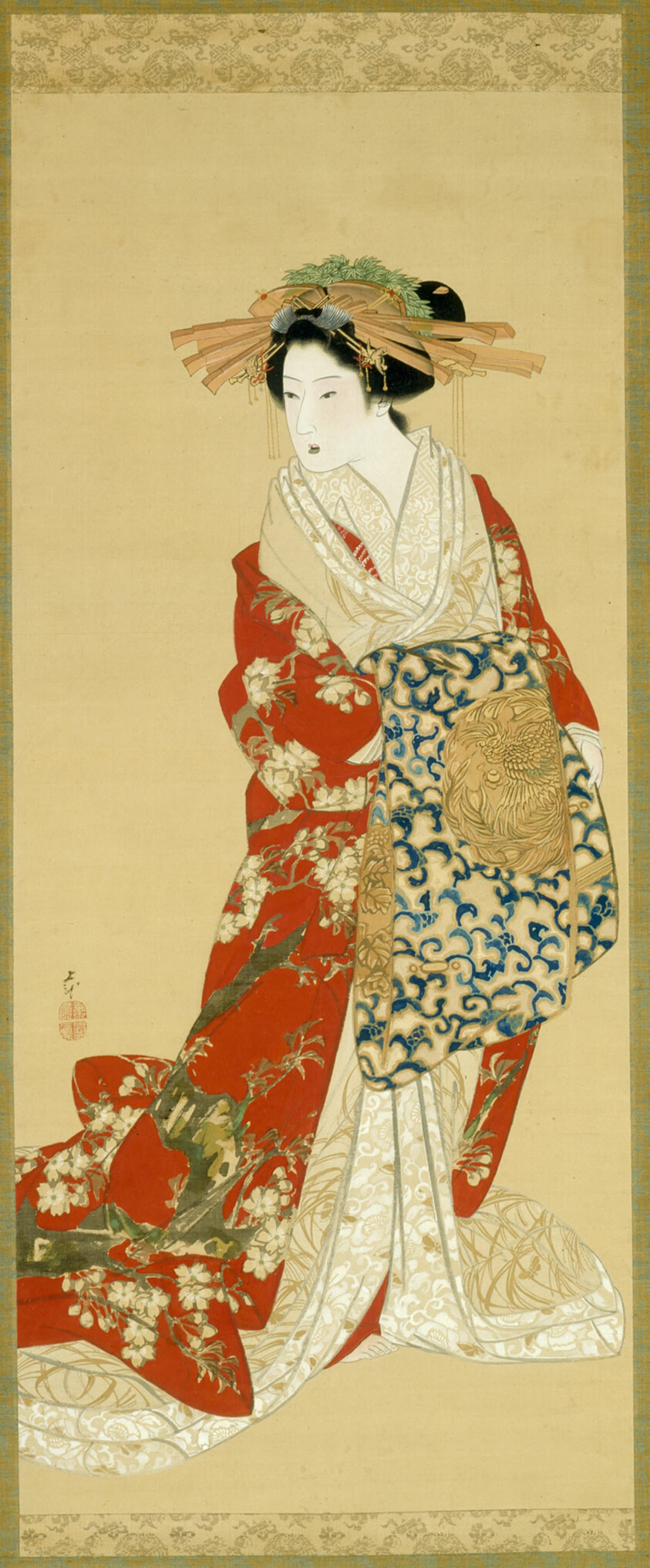
Heritage Research Artifact: The High Ranking Courtesan
Category: Silk
In the hallowed corridors of London’s Savile Row, where cloth is not merely fabric but a testament to lineage and precision, the heritage of silk craftsmanship converges with an unexpected muse: the high-ranking courtesan. This artifact—executed in ink, color, and gold on silk—represents a pinnacle of materiality and cultural narrative, demanding scholarly scrutiny through the lens of heritage management. As Senior Heritage Specialist for the Lauren Fashion Heritage Lab, I present this analysis as a bridge between the tactile elegance of classic silk and the fluid, often elusive, elegance of a figure who commanded both artistry and agency.
Materiality and Craftsmanship: The Silk Canvas
Silk, as a substrate, is not passive. Its origins in the mulberry-fed sericulture of East Asia, refined over millennia, render it a medium of extraordinary sensitivity. The artifact under examination employs a handwoven silk ground, likely a satin weave or damask, chosen for its ability to absorb and reflect light—a quality essential for the interplay of ink, color, and gold. The application of mineral pigments, such as cinnabar for vermillion and azurite for blue, alongside gold leaf or powdered gold, speaks to a workshop tradition where material cost mirrored social value. The gold, in particular, is not decorative excess but a deliberate signifier of status: it catches the eye, much like the courtesan herself, demanding attention while resisting full possession.
The fluidity of the silk’s drape is echoed in the brushwork. Ink lines, likely from a calligraphic hand, define contours with a precision that suggests training in literati painting—a skill often cultivated by courtesans to navigate elite circles. The colors, layered in washes, create a sense of movement: a sleeve billows, a sash loosens, a fan half-opens. This is not static portraiture but a choreography of gesture, where the silk’s own pliability becomes part of the composition. The gold, applied in fine strokes, traces embroidery patterns on robes or highlights hair ornaments, reinforcing the courtesan’s role as a living artifact of luxury.
Historical Context: The High Ranking Courtesan as Cultural Capital
To understand this artifact, one must situate the high-ranking courtesan within a hierarchy of social performance. In Edo-period Japan, for instance, the oiran or tayu were not merely sex workers but arbiters of fashion, poetry, and music. Similarly, in 19th-century Paris, the demi-mondaine like Marie Duplessis wielded influence through taste. The courtesan’s body became a canvas for silk craftsmanship—kimonos, gowns, and obis were commissioned from master weavers, often with motifs that signaled her patronage or wit. The artifact, therefore, is not a portrait of an individual but a document of a system where materiality and reputation were inseparable.
The choice of silk as medium is critical. Silk’s association with luxury, but also with transience—its susceptibility to fading, tearing, and decay—mirrors the courtesan’s own precarious status. She is both celebrated and marginalized, immortalized in gold yet subject to the ravages of time. This tension is central to heritage interpretation: the artifact preserves her image, but the silk’s fragility reminds us that preservation is an act of selection, not inevitability.
Fluid Elegance: Aesthetic and Symbolic Dimensions
The phrase “fluid elegance” is not mere poetics but a technical descriptor. In the artifact, fluidity manifests through the asymmetric composition—the courtesan’s body is often depicted in a slight S-curve, a posture derived from classical Chinese painting that suggests both poise and potential movement. The gold lines, applied with a kirikane technique (cut gold leaf), create a shimmering surface that shifts with viewing angle, mimicking the play of candlelight on silk. This is elegance as performance: the courtesan is always aware of being seen, and the artifact captures that self-conscious grace.
Symbolically, the motifs embedded in the silk—cherry blossoms, flowing water, or cranes—carry layered meanings. Cherry blossoms evoke ephemeral beauty, a nod to the courtesan’s fleeting youth. Water suggests adaptability, a quality essential for navigating social hierarchies. Gold, meanwhile, signifies both wealth and the immutable: it does not tarnish, offering a permanence that the courtesan’s life lacks. The artifact thus becomes a paradox: it celebrates her agency while acknowledging her commodification.
Heritage Implications: Preservation and Interpretation
From a heritage management perspective, this artifact poses distinct challenges. The silk’s organic nature requires controlled humidity and light exposure; the gold leaf is prone to flaking. Yet its value lies not only in material survival but in the narratives it enables. As a heritage specialist, I advocate for a contextual preservation approach: the artifact should be displayed alongside period textiles, tools of silk weaving, and historical accounts of courtesan culture. This avoids reducing the courtesan to a decorative object and instead positions her as a producer of cultural meaning.
Furthermore, the artifact invites dialogue with contemporary fashion. The fluidity of silk and the courtesan’s aesthetic of controlled opulence resonate with designers like Alexander McQueen or John Galliano, who have drawn on historical silhouettes and materials. The Lauren Fashion Heritage Lab’s mission—to bridge past and present—finds a natural ally here. By studying how silk, ink, and gold were deployed to construct identity, we inform modern practices of luxury branding and craftsmanship.
Conclusion: A Legacy in Silk
The high-ranking courtesan, rendered in ink, color, and gold on silk, is more than a historical curiosity. She is a testament to the power of materiality to encode social complexity. The silk’s weave, the gold’s gleam, the ink’s flow—all speak to a system where elegance was both a weapon and a shield. For the heritage scholar, this artifact demands rigorous attention to craft, context, and conservation. For the fashion industry, it offers a masterclass in the interplay of texture and narrative. In the spirit of Savile Row, where every stitch tells a story, this artifact reminds us that heritage is not static; it is a living dialogue between the hand that made and the eye that beholds.