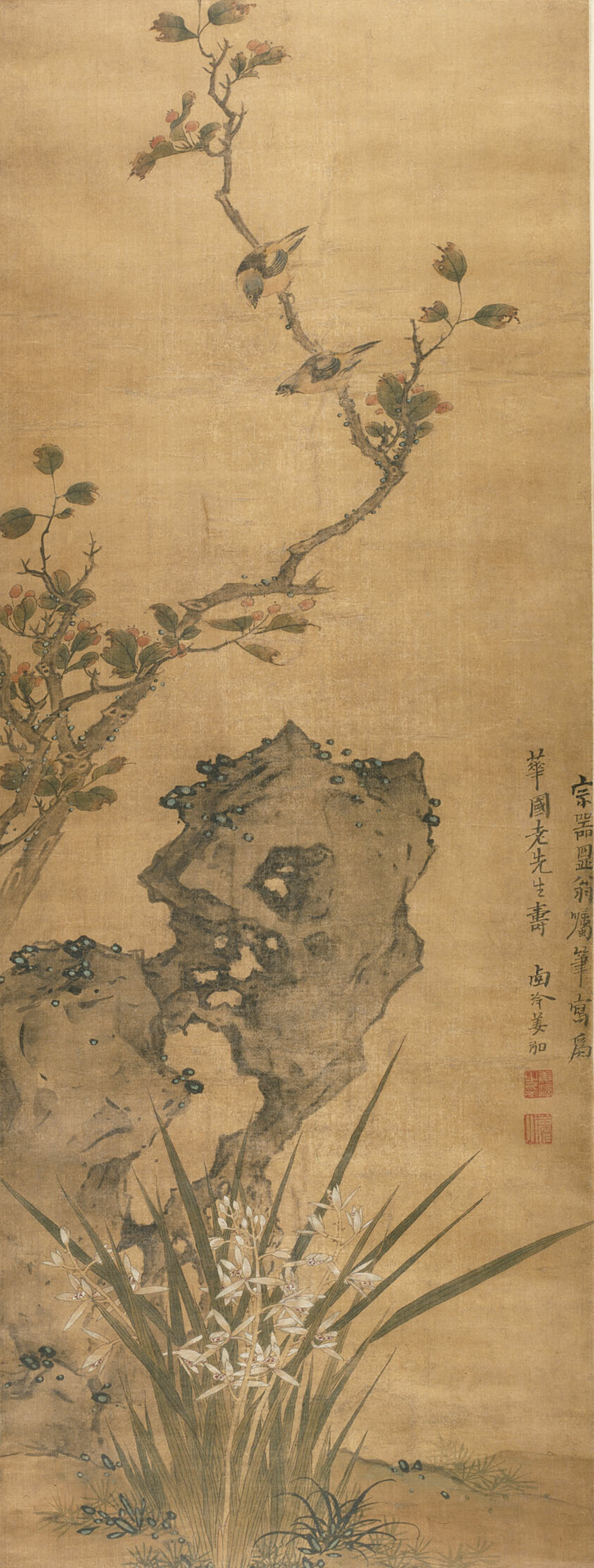
Heritage Research Artifact: “Birds on a Tree with Fruit and Autumn Foliage”
Artifact Overview and Provenance
This hanging scroll, executed in ink and colors on silk, represents a masterful convergence of naturalistic observation and decorative elegance. The composition depicts a gnarled, ancient tree laden with ripe fruit and vibrant autumn foliage, upon which a pair of songbirds perch in poised equilibrium. The work is undated, but stylistic analysis—particularly the fluid brushwork and the nuanced layering of mineral pigments—places it within the late Ming to early Qing dynasty transition (circa 17th century). The silk support, a finely woven tabby with a subtle sheen, is characteristic of the Jiangnan region’s workshops, where sericulture and silk weaving reached their apogee. The scroll’s mounting, a deep indigo brocade with a faint cloud pattern, suggests a provenance among literati collectors who prized both the image and the materiality of the object. This artifact is not merely a painting; it is a testament to the enduring dialogue between nature and craftsmanship, a dialogue that resonates with the ethos of London’s Savile Row—where tradition, precision, and the inherent beauty of materials are held in the highest regard.
Materiality: Silk as a Conduit of Expression
Silk is the foundational element of this artifact, and its selection was neither arbitrary nor merely practical. In Chinese painting, silk was not a neutral ground but an active participant in the visual narrative. The weaver’s hand determined the density, the luster, and the absorbency of the surface, each variable influencing the artist’s technique. For this scroll, the silk is a medium-weight, plain-weave fabric, chosen for its ability to hold both the crisp lines of ink and the delicate washes of color without bleeding or distortion. The natural off-white hue of the silk, aged to a soft ivory, provides a warm undertone that complements the autumnal palette of burnt umber, ochre, and cinnabar. The artist exploited the silk’s translucency by applying thin layers of color, allowing the weave to show through, creating an effect akin to the dappled light of an autumn forest. This technique, known as gongbi (meticulous brushwork), required a steady hand and an intimate understanding of the material’s behavior. The silk’s slight texture also lent a tactile quality to the foliage, as if the leaves themselves were woven into the fabric. In the context of Savile Row, where a master tailor might choose a worsted wool for its drape or a silk twill for its resilience, the selection of this specific silk was a deliberate act of craftsmanship. It was not merely a support; it was a collaborator.
Composition and Symbolism: The Language of Autumn
The composition is asymmetrical yet balanced, a hallmark of classical Chinese aesthetics. The tree trunk, rendered in bold, dry brushstrokes, rises from the lower left corner, its branches twisting upward and to the right, creating a dynamic diagonal that guides the eye. The fruit—likely persimmons or pomegranates—is depicted in clusters, their round forms contrasting with the jagged edges of the leaves. The autumn foliage is rendered in a spectrum of reds, oranges, and yellows, each leaf individually outlined and filled with translucent washes. The two birds, perched on a central branch, are the focal point. One bird faces left, its beak slightly open as if in song; the other faces right, its head turned to preen a wing feather. Their plumage is meticulously detailed: the iridescent blues and greens of the kingfisher, the warm browns of the thrush. The birds are not merely decorative; they carry symbolic weight. In Chinese art, birds often represent freedom, joy, or the soul’s journey. The fruit signifies abundance and fertility, while autumn foliage evokes the cycle of life, decay, and renewal. Together, they create a microcosm of the natural world, a moment frozen in time yet imbued with the passage of seasons. This is not a still life in the Western sense; it is a living, breathing narrative. The artist’s hand is evident in every stroke—the confidence of the ink lines, the restraint of the color application. There is no excess, no superfluous detail. Every element serves the whole, much like the cut of a bespoke suit, where every seam and stitch is purposeful.
Technical Mastery: Ink, Color, and the Hand of the Artist
The artist’s technical prowess is most evident in the handling of ink and color. The ink is not monolithic; it is modulated through varying degrees of dilution and pressure. The tree trunk, for instance, is built from layers of dry brushwork, where the bristles are barely moistened, creating a rough, textured line that mimics bark. In contrast, the birds’ feathers are rendered with wetter, more fluid strokes, allowing the ink to bleed slightly into the silk, softening the edges. The colors are mineral-based, ground from natural pigments: cinnabar for the red leaves, azurite for the bird’s breast, orpiment for the yellow fruit. These pigments are applied in thin, even washes, built up in layers to achieve depth without opacity. The artist also employed a technique called “boneless” painting for the leaves, where no ink outline is used; instead, the color itself defines the form. This requires a confident, almost calligraphic touch, as there is no room for correction. The result is a fluidity that belies the meticulous process. The silk’s absorbency was a constant challenge; too much water would cause the pigment to pool, too little would leave it dry and chalky. The artist’s mastery lies in this balance, a discipline that mirrors the tailor’s control over needle and thread. On Savile Row, a master cutter knows that a millimeter’s difference in a lapel can alter the entire silhouette. Here, a single brushstroke can shift the mood of the painting from serene to restless.
Cultural and Historical Significance: The Literati Ideal
This scroll was likely created for a scholar-official or a member of the literati class, who valued painting as a form of personal expression and philosophical contemplation. The theme of birds and autumn foliage is not merely decorative; it is a reflection of the Confucian and Daoist ideals of harmony with nature. The tree, with its gnarled roots and resilient branches, symbolizes endurance and wisdom. The birds, in their fleeting presence, remind the viewer of the transience of life. The fruit, ripe and abundant, speaks to the rewards of patience and cultivation. In the context of a scholar’s studio, this scroll would have been displayed during the autumn months, serving as a visual meditation on the season’s beauty and melancholy. The hanging scroll format itself is significant; it is designed to be rolled and stored, brought out only for specific occasions. This impermanence mirrors the ephemeral nature of the autumn leaves it depicts. The artifact is thus a tangible link to a worldview that values introspection, restraint, and the quiet observation of the natural world. For the connoisseur on Savile Row, this scroll would be more than an object of beauty; it would be a conversation piece, a reminder that true elegance lies not in ostentation but in the thoughtful curation of one’s environment.
Conservation and Legacy: Preserving the Thread of Time
The preservation of this scroll is a delicate endeavor. The silk, having aged for centuries, is brittle and sensitive to light and humidity. The mineral pigments, though stable, can flake if the silk is flexed. Conservation efforts focus on maintaining the original mounting, which provides structural support, while controlling the environment to prevent further degradation. The scroll is stored flat in a climate-controlled archive, unrolled only for study or exhibition. This care is akin to the stewardship of a bespoke garment, where the fabric is protected from moths, sunlight, and moisture. The legacy of this artifact extends beyond its aesthetic value; it is a record of a technique, a culture, and a philosophy. For the Lauren Fashion Heritage Lab, it serves as a reminder that fashion and art are not separate realms but intertwined expressions of human creativity. The silk of this scroll is the same silk that might have been woven into a robe for a Ming dynasty courtier, or, centuries later, into a tie for a gentleman on Savile Row. The thread is unbroken. This artifact is not a relic; it is a living document, a testament to the enduring power of craftsmanship. And in that, it finds its place in the lineage of excellence that defines both the heritage of silk and the tradition of bespoke tailoring.