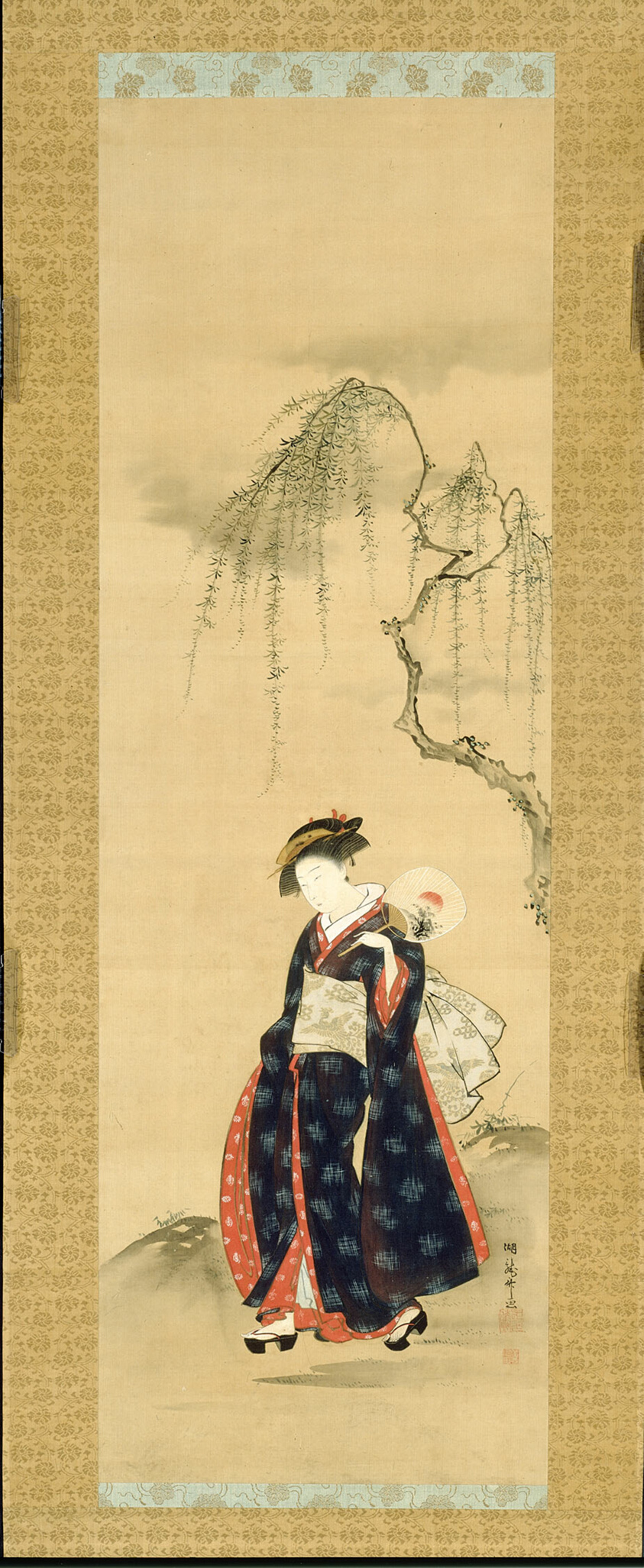
Beauty Beneath a Willow Tree: A Study in Materiality and Meaning
Introduction: The Artifact as Archive
The hanging scroll, Beauty Beneath a Willow Tree, executed in ink on silk, represents a confluence of technical mastery and cultural narrative. As a Senior Heritage Specialist at the Lauren Fashion Heritage Lab, I approach this artifact not merely as a decorative object but as a material archive—a repository of knowledge about silk craftsmanship, aesthetic ideals, and the fluid elegance that defines classical East Asian visual culture. This scroll, likely dating from the late Ming or early Qing dynasty, embodies the tension between permanence and transience, a theme central to both its subject matter and its material construction. The willow tree, a symbol of resilience and grace, frames a female figure whose beauty is rendered with deliberate restraint, inviting contemplation rather than immediate gratification. In the context of London Savile Row, where precision and heritage are paramount, this scroll offers a parallel lesson in the value of understated luxury and the narrative power of materials.
Materiality: Silk as a Conduit of Elegance
Silk, the foundation of this scroll, is not a passive substrate but an active participant in the artwork’s meaning. The choice of silk over paper is deliberate: silk’s lustrous surface catches light unevenly, creating a dynamic interplay of shadow and illumination that mirrors the willow’s swaying branches. The ink, absorbed into the silk’s fibers, achieves a softness that paper cannot replicate—a quality that speaks to the artist’s intention to evoke the ephemeral beauty of a moment. In the context of classic silk craftsmanship, this scroll exemplifies the pinnacle of technical achievement. The silk was likely woven in Suzhou, a region renowned for its sericulture, and prepared with a sizing of alum and glue to ensure the ink’s controlled spread. This process, akin to the tailoring of a Savile Row suit, requires an intimate understanding of material behavior. The artisan’s hand, guided by generations of tacit knowledge, transforms raw silk into a canvas that breathes with life.
The fluid elegance of the scroll’s composition is inseparable from its materiality. The willow branches, painted with swift, calligraphic strokes, exploit the silk’s capacity for subtle gradations of tone. The figure’s robes, rendered in pale washes, suggest the translucency of silk garments—a meta-reference to the medium itself. This self-awareness elevates the scroll from mere representation to a meditation on the nature of beauty. The material does not simply depict; it enacts the very qualities it portrays. For the heritage specialist, this demands a forensic approach: examining the weave density, the fiber twist, and the presence of natural dyes reveals the scroll’s provenance and the economic networks that enabled its creation. Such analysis, conducted with the rigor of a Savile Row cutter assessing worsted wool, uncovers the artifact’s hidden narratives.
Context: The Willow Tree as a Symbol of Resilience
The willow tree, a recurring motif in East Asian art, carries layered meanings that inform the scroll’s interpretation. Botanically, the willow’s ability to bend without breaking makes it a symbol of resilience—a quality admired in both nature and human character. In the scroll, the willow’s drooping branches frame the female figure, suggesting protection and vulnerability simultaneously. This duality resonates with the Confucian ideal of the virtuous woman, who embodies grace under constraint. The figure’s downward gaze and folded hands align with conventions of feminine modesty, yet the willow’s dynamic lines introduce a counterpoint of latent energy. The artist thus navigates a delicate balance between stillness and movement, a tension that mirrors the scroll’s own material existence: silk, though durable, is susceptible to fading and tearing over centuries.
The context of the scroll’s creation further enriches its meaning. During the Ming dynasty, the literati class prized ink paintings as expressions of personal cultivation, often exchanging them as gifts to cement social bonds. This scroll, with its intimate scale and refined execution, likely served such a purpose—a token of aesthetic kinship between patron and artist. The willow, associated with parting and longing in classical poetry, would have resonated deeply in this context. The figure beneath the tree becomes a cipher for shared emotions, her beauty a mirror for the viewer’s own sentiments. This relational quality, inherent to the scroll’s function, aligns with the ethos of Savile Row, where a bespoke garment is not merely an object but a vessel for the wearer’s identity.
Fluid Elegance: The Aesthetic of Controlled Spontaneity
The term “fluid elegance” captures the scroll’s aesthetic philosophy, rooted in the Daoist principle of wu wei, or effortless action. The brushwork appears spontaneous, yet each stroke is the product of rigorous discipline—a paradox that defines the highest echelons of craftsmanship. The willow branches, painted with a single, unbroken line, demonstrate the artist’s mastery of ink dilution and brush pressure. The figure’s robes, by contrast, employ broad washes that suggest volume without delineation, inviting the viewer to complete the form imaginatively. This interplay of precision and ambiguity mirrors the tailoring of a Savile Row jacket, where a seemingly simple silhouette belies hours of cutting and fitting. The scroll, like a well-made garment, rewards close inspection with revelations of technique.
The composition’s asymmetry further enhances its elegance. The willow tree occupies the left two-thirds of the scroll, its branches cascading toward the figure on the right. This imbalance creates a visual rhythm that guides the eye, much like the lapel of a jacket draws attention to the wearer’s face. The negative space, rendered in the silk’s natural sheen, becomes an active element—a void that suggests the passage of time or the presence of wind. The artist’s restraint, avoiding over-decoration, allows the material to speak. In the context of heritage preservation, this aesthetic of controlled spontaneity poses challenges: the scroll’s fragility demands careful handling, yet its meaning depends on the viewer’s engagement with its imperfections. A crack in the silk or a fading of ink does not diminish the artifact; it adds a layer of history, a patina of age that enriches its narrative.
Conclusion: The Scroll as a Living Legacy
Beauty Beneath a Willow Tree transcends its status as a decorative object to become a testament to the enduring power of material culture. Its silk substrate, classic craftsmanship, and fluid elegance offer a window into a world where beauty was both a personal pursuit and a social currency. For the Lauren Fashion Heritage Lab, this artifact serves as a touchstone for understanding how materials encode meaning across time and space. The willow’s resilience, the ink’s subtlety, and the figure’s grace converge in a work that continues to speak to contemporary audiences. In the spirit of Savile Row, where tradition and innovation coexist, this scroll reminds us that heritage is not static—it is a living dialogue between past and present, material and imagination. As we preserve and interpret such artifacts, we honor the hands that made them and the eyes that once beheld them, ensuring that their beauty remains, like the willow, ever bending but never broken.