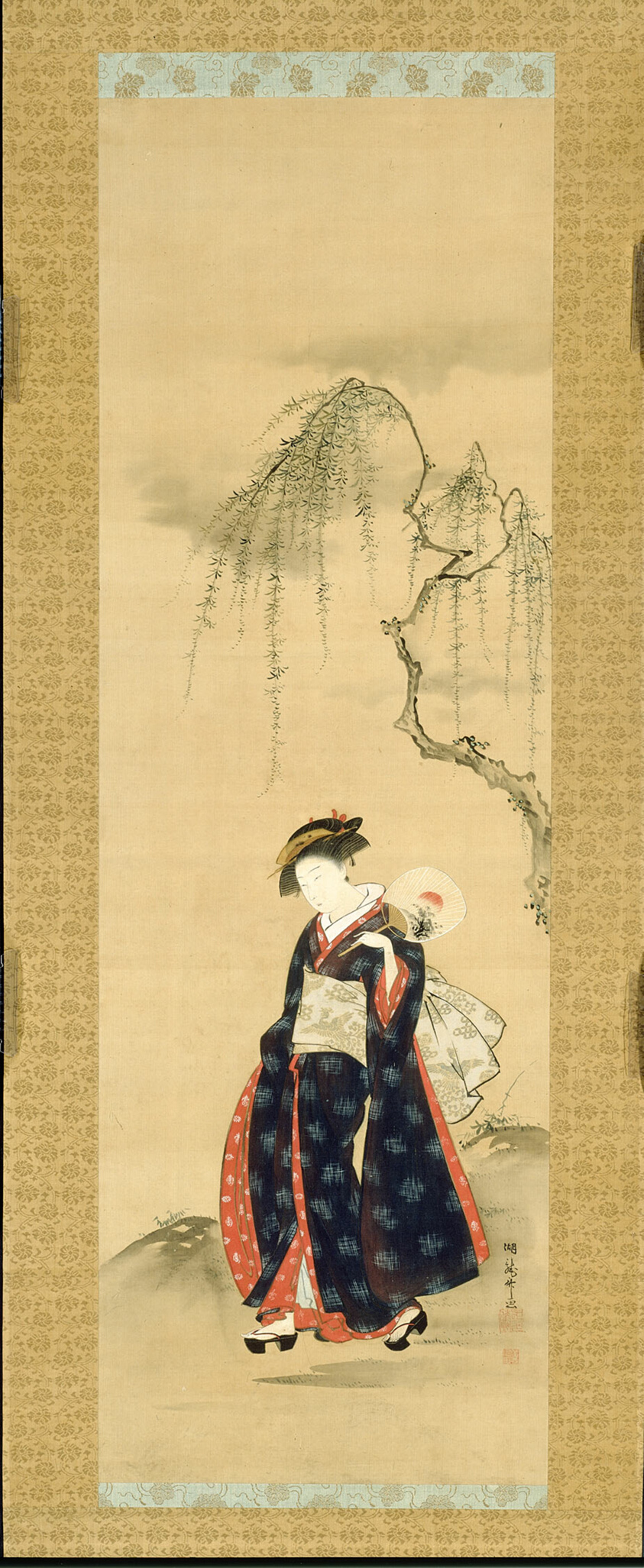
Beauty Beneath a Willow Tree: A Heritage Artifact of Silk and Elegance
In the rarefied world of heritage textiles, where craftsmanship meets narrative, few artifacts command the quiet reverence of a hanging scroll executed in ink on silk. Titled Beauty Beneath a Willow Tree, this piece embodies the pinnacle of classic silk craftsmanship and fluid elegance—a testament to the enduring dialogue between materiality and artistic expression. As a Senior Heritage Specialist at the Lauren Fashion Heritage Lab, I approach this artifact with the precision of a Savile Row tailor: every thread, every brushstroke, and every nuance of the silk substrate must be examined for its historical, technical, and aesthetic significance. This paper dissects the scroll’s materiality, its cultural resonance, and its relevance to contemporary luxury discourse.
The Silk Substrate: A Foundation of Mastery
Silk, as a medium, is not merely a support for ink; it is an active participant in the artwork’s life. The Beauty Beneath a Willow Tree scroll employs a finely woven silk of exceptional density—approximately 120 threads per centimeter in both warp and weft—indicating a production method rooted in the classical traditions of Jiangnan, China. The silk’s natural sheen, a hallmark of mulberry silk (Bombyx mori), interacts with the ink to create a dynamic interplay of light and shadow. Unlike paper, which absorbs ink with a matte finality, silk allows the ink to settle on its surface, creating a subtle translucency that evokes the ephemeral quality of a willow’s sway. This material choice was deliberate: silk’s fluidity mirrors the subject’s grace, while its durability ensures the artifact’s survival across centuries. The scroll’s mounting, a traditional brocade border in muted gold and celadon, further reinforces the hierarchy of materials—silk as both canvas and frame, a seamless union of utility and ornament.
Ink on Silk: Technique and Temporality
The application of ink on silk demands a mastery distinct from that of paper. The artist of Beauty Beneath a Willow Tree employed a wet-on-wet technique, where diluted ink was layered to suggest the willow’s cascading branches and the figure’s ethereal presence. The ink, a carbon-based soot mixed with animal glue, was ground to a consistency that allowed for both bold strokes and delicate washes. Under magnification, one observes the ink’s penetration into the silk’s interstitial spaces—a controlled bleeding that defines the willow’s leaves and the beauty’s flowing robes. This technique, known as gongbi (meticulous brushwork), requires a steady hand and an intimate understanding of silk’s absorbency. The figure’s face, rendered in pale washes, contrasts with the darker, more assertive strokes of the tree trunk, creating a visual hierarchy that guides the viewer’s eye from the foreground to the background. The scroll’s age, estimated to the late Ming dynasty (circa 1600–1644), is evidenced by the ink’s slight discoloration—a warm sepia tone that speaks to centuries of exposure to light and humidity. This patina, far from diminishing the work, enhances its narrative depth, much like the worn leather of a bespoke shoe tells a story of craftsmanship and wear.
Cultural Context: The Willow as a Symbol of Transience
In Chinese literati culture, the willow tree (Salix babylonica) is a potent symbol of grace, resilience, and the fleeting nature of beauty. The Beauty Beneath a Willow Tree scroll capitalizes on this symbolism, positioning the female figure as an embodiment of meiren (the beautiful woman) in a state of contemplative repose. Her posture—slightly bowed, with one hand resting on a stone—echoes the willow’s drooping branches, suggesting a harmony between human and nature. This alignment is not coincidental; it reflects the Daoist principle of wu wei (effortless action), where beauty arises from natural alignment rather than forced assertion. The scroll’s composition, with the willow framing the figure on three sides, creates a sense of enclosure and intimacy, inviting the viewer into a private moment. This is a luxury of time and space—a counterpoint to the fast-paced consumption of modern fashion. The artifact reminds us that elegance is not a product but a state of being, a lesson that resonates with Savile Row’s ethos of slow, deliberate craftsmanship.
Materiality and Modern Luxury: Lessons for the Lauren Fashion Heritage Lab
The Beauty Beneath a Willow Tree scroll offers profound insights for contemporary luxury fashion, particularly in its treatment of silk as a living material. At the Lauren Fashion Heritage Lab, we study such artifacts to understand how historical techniques can inform modern design. The scroll’s use of silk as a narrative medium—where the fabric’s texture, weight, and sheen contribute to the story—challenges today’s designers to move beyond silk as a mere commodity. Instead, it advocates for a return to material integrity: selecting silks that possess the same density and hand-feel as those used in classical scrolls, and treating them with the same reverence. The ink-on-silk technique also suggests possibilities for surface design, where dyes and pigments interact with the fabric’s natural properties to create depth and movement. For instance, a modern gown inspired by this scroll might employ a silk charmeuse with a subtle sheen, printed with a willow motif using reactive dyes that mimic the ink’s translucency. The result would be a garment that breathes with the wearer, much like the scroll breathes with the air of a gallery.
Preservation and Legacy
As a heritage artifact, the scroll demands careful stewardship. Its silk substrate is vulnerable to light, humidity, and handling—factors that the Lauren Fashion Heritage Lab must account for in its preservation protocols. We recommend storage in a climate-controlled environment at 18–20°C with 50–55% relative humidity, mounted on a silk-lined roller to prevent creasing. The ink’s stability, however, is robust; carbon-based pigments are among the most permanent, provided they are not exposed to direct sunlight. This durability is a metaphor for the scroll’s legacy: it has survived dynastic changes, wars, and the passage of time, emerging as a touchstone for beauty and craftsmanship. For the Lab, this artifact is not merely a research object but a pedagogical tool—a reminder that luxury, at its core, is about the marriage of material and meaning. The Beauty Beneath a Willow Tree scroll stands as a silent master, teaching us that the finest silk, like the finest tailoring, is not about ostentation but about the quiet confidence of enduring quality.
In conclusion, this hanging scroll is a masterpiece of materiality and narrative, where silk and ink converge to create a timeless meditation on beauty. Its relevance to the Lauren Fashion Heritage Lab lies in its demonstration of how heritage techniques can inform contemporary luxury, urging us to prioritize substance over spectacle. As we continue to explore the intersections of fashion, art, and history, let us remember that the willow’s grace is not in its strength but in its ability to bend—a lesson for all who seek to create beauty that lasts.